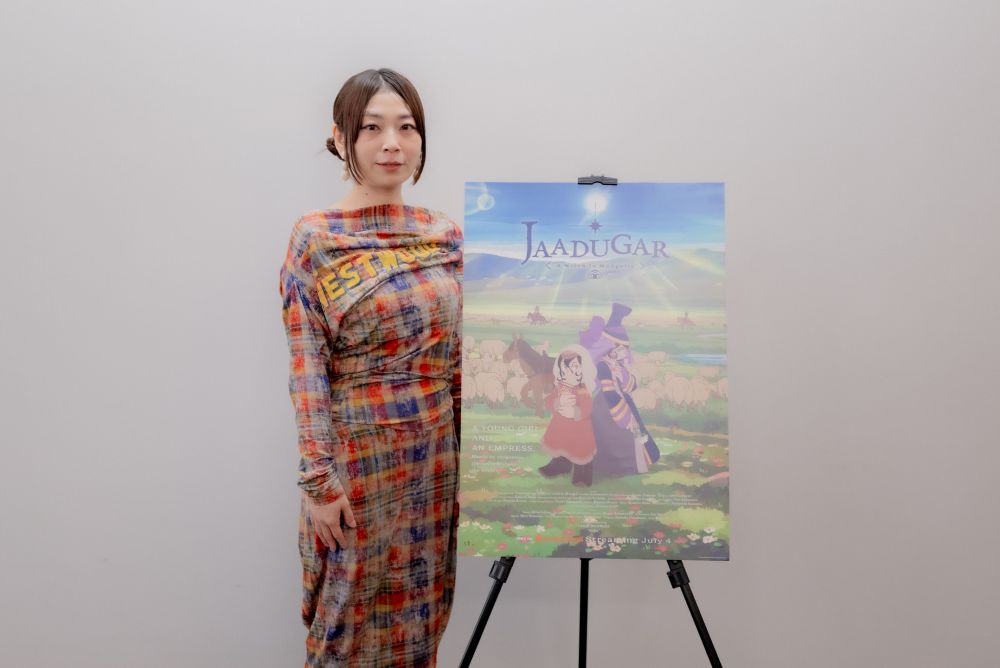

At Anime Expo 2026, the U.S. PREMIERE of the anime series “Jaadugar: A Witch in Mongolia” was met with an overwhelmingly enthusiastic reception. In addition to the exclusive advance screening of Episodes 1 and 2, the panel offered a deep dive into the making of the series, with the creators sharing behind-the-scenes production stories and discussing the unique appeal of the upcoming animated series.
We sat down with Executive Director Naoko Yamada to hear her approach and thoughts on “Jaadugar: A Witch in Mongolia”.
Q:Please tell us how you came to participate in Jaadugar: A Witch in Mongolia.
Hearing that Abel-san would be directing, I was very interested in seeing what kind of work he would make. When you are directing yourself, you rarely get to see other directors at work, so I thought this was a great opportunity. Therefore, if there was anything I could do, I wanted to take part, and that is how I ended up participating as the executive director.
In actually working with Abel-san, I realized he is someone who can properly say “no.” I think that is a very important quality for a director. So many people bring various ideas to the table, and while they might all be wonderful, he has the eye to choose which ones will work the best, or rather, the ability to see beyond just what seems good on the surface. I believe that is what gives him the power to say “no.”
Q:If you were to express the appeal of this work in a single word, what kind of work do you think it is?
It’s difficult, but if I had to express it in one word, it would be something like “conviction.” I think it is a work that brings together the unwavering belief of everyone involved.
Q:Upon adapting this into an anime, please tell us about the themes or messages you particularly cherished in this work.
What we are careful about as the people creating the animation is to not look at things from only one angle. We place great importance on creating, holding respect and reverence for both cultures and ways of thinking.
So I hope the viewers will see this work with an open mind, take it in, and reflect on it. It’s more about hoping that this becomes the viewer’s own personal story.
Q:How do you incorporate elements such as “historicity,” “culture,” and “values” into the work?
I share a mutual understanding with Abel-san that we want to treat this carefully. In depicting Persia and Mongolia, we want to capture that subtle essence where their religious views or daily way of are felt even within the most trivial lines of dialogue. For example, on the Islamic side, phrases like “in the name of Allah” are used casually in everyday life, while on the Mongolian side, there’s a very strong sense of nature worship and reverence for heaven and earth, like saying “Let’s leave it to Heaven.” We make sure to cherish their underlying values woven within these small bits of dialogue.
Q:Is there an event that particularly left an impression on you during production?
Character designer Kenichi Yoshida-san is incredibly knowledgeable about history—he especially loves Mongolian history. Every time we meet for meetings and such, he teaches me about a large number of historical events. He was really like a history teacher; his stories are fascinating, and he spoke about it with so much joy. I feel like that naturally trickled its way into the story as well. Because he talked about it with such genuine affection, I found myself growing more and more fond of Mongolia, too.
Q:In terms of direction this time, were there any differences from your previous works or any new challenges?
The manga-like screen composition, and the proportions of the character designs being a bit unique and stylized. Breathing life into something like this and animating it to look appealing isn’t something I have much experience in, so it was definitely a massive challenge. I’ve often used techniques like realistic camera work or a lens-based perspective in the past, but I completely avoided using such methods this time. Seeing how much depth we could bring to this world through color palettes and layout composition, while also keeping it as visually captivating as an illustration—that aspect was very challenging and incredibly fun.
Q:Please tell us the points you were particularly particular about regarding the emotional expression of the characters.
I placed great importance on depicting exactly how the character listening is reacting to the character speaking. I believe this ties directly into the viewer’s imagination, so I paid close attention to even the smallest details like exactly where their gaze is directed, because I think those things are conveyed subconsciously through the screen.
Q:Please tell us about a scene that left a strong impression on you in this work, and the directorial intent behind it.
It’s a story with a pretty serious ongoing plot, but there are also comical scenes here and there. I feel like those moments tie into the characters’ charm, and I think it also gives the audience a sense of relief. The characters are incredibly cute, and there are quite a few scenes like that, so I personally look forward to and love those parts.
Q:Please tell us your recommended way of watching for people experiencing this work for the first time.
I think that this show is the kind of project that pulls you in as you watch it. In addition, the music was also created separately for the Persia arc and the Mongolia arc, so I think that’s another angle you can enjoy. By all means, I hope you enjoy it on a large screen with the volume turned up, paying close attention to every little detail.